


Animal welfare is a critical factor in evaluating the quality of life for animals in captive environments. Utilizing the Five Domains model, specifically the Environment and Nutrition domains, facilities and keepers can improve enclosures based on quantitative data and design principles. However, in practice, many spacious enclosures equipped with pools and greenery still see animals with low interaction levels or even stereotypical behaviors, indicating poor behavioral engagement and a negative mental state. This indicates poor interaction between the animals and their environment, as well as a negative mental state. Why does this happen, and what can we do to change it?
1. What is Enrichment?
For captive animals, providing space, food, and water is insufficient; they must also be able to express natural behaviors such as foraging, hunting, and movement. In the wild, animals spend the majority of their day foraging; for instance, wild elephants spend 18 to 20 hours a day travelling an average of 25 km to find food. In captivity, restricted space and pre-provided meals significantly reduce foraging time, leading to increased “idle time” and the development of stereotypical or abnormal behaviors.
This understanding led to the development of the concept of enrichment, which provides ideas and methods for improving the living environment of captive animals in order to enhance their welfare.
Enrichment is a dynamic process designed to improve an animal’s environment within the context of its behavioral biology and natural history. These environmental modifications aim to increase behavioral choices and encourage species-appropriate actions, thereby enhancing welfare.
An enrichment programme should be comprehensive and include five categories of enrichment to ensure that all aspects of the animal’s environment are considered. These categories are not mutually exclusive or conflicting. Instead, each should be applied appropriately as part of an overall enrichment strategy.
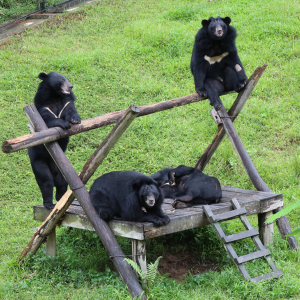
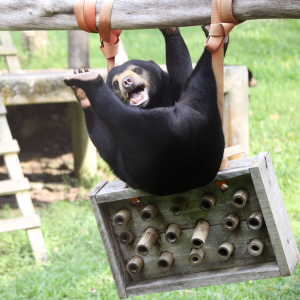
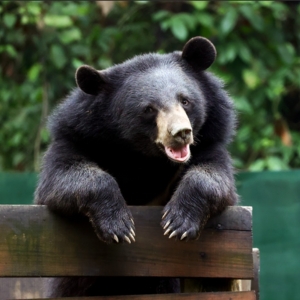
Rescued bears at Tam Dao Bear Sanctuary, Vietnam. Source: Animals Asia Foundation.
Tam Dao Bear Sanctuary, Vietnam – Animals Asia
2. Types of Environmental Enrichment
In this article, I would like to introduce the five categories of enrichment described by the Smithsonian’s National Zoo and Conservation Biology Institute, including:
- Social: This involves considering the species’ natural social structure whether they are group living, solitary, or territorial and their interactions with other species. While interaction with humans (keepers, vets, visitors) is inevitable, negative impacts must be minimized to ensure the safety of both humans and animals.
- Cognitive: Cognitive enrichment encourages animals to think and use their cognitive abilities. This includes providing novel experiences, promoting active learning through positive reinforcement training, and encouraging problem-solving. Training should be challenging without causing frustration, and training plans should be adjusted as each individual successfully completes new tasks. The primary purpose of positive reinforcement training is to support proactive veterinary care for the individual animal, minimizing the negative impacts of veterinary examinations while enabling veterinarians to monitor and treat the animal more effectively.
- Habitat: Modifying the environment provides animals with new experiences. Adding trees, climbing structures, perches, or different substrates such as sand, mulch, or grass can encourage animals to explore their surroundings in new ways. Animal keepers can also provide a variety of shelters and bedding materials.
- Sensory: Scents and sounds encourage animals to explore their environment. Natural scents from predators or prey, together with novel scents such as spices or diluted perfumes, can be applied to the ground or sprayed onto logs for animals to investigate. Playing recorded sounds, such as insects or birdsong, can help simulate the sounds of a natural habitat.
- Food: Food can be presented in puzzle feeders, hidden, frozen in ice, buried, or scattered throughout the enclosure. Making food part of daily enrichment encourages captive animals to search and work for their food, just as they would in the wild. Extending the amount of time animals spend foraging each day and providing sufficient food, particularly for social species housed in groups, helps keep animals active and reduces negative behaviors directed toward themselves or other group members.
An enrichment plan should be designed to achieve one or more specific objectives. Behavioral goals should be established to guide the development of enrichment plans and schedules. These goals may be broad (for example, increasing exploratory behavior) or specific (for example, encouraging olfactory exploration). Before implementing an enrichment programme, baseline behavioral data should be collected, and methods for evaluating the animal’s response should be established. This helps determine whether the enrichment programme achieves its intended behavioral objectives and how long those effects are maintained. The data collected also provide valuable information for modifying the programme if the desired objectives are not achieved.
3. Design Ideas for Enrichment
Depending on the species and its natural behavior, animal care staff can develop enrichment items that are appropriate for each animal. For all animals, one of the strongest natural instincts is to search for food when they are hungry. This is especially true for wild animals, which spend a large proportion of their time foraging. As a result, enrichment ideas that increase the challenge of obtaining food are among the most commonly used.
The purpose of hiding food is to encourage animals to search for it, thereby increasing the amount of time they spend foraging. Foods with a strong scent are generally the most suitable for hiding, as they leave an olfactory trail that encourages animals to use their sense of smell to locate the food. Natural essential oils can also be used to stimulate the animal’s olfactory senses. For example, for Asiatic black bears (moon bears), honey or fruit jam can be spread on toys, tree branches, or structures to encourage the bears to search for them. Fruits such as jackfruit or passion fruit can also be hidden in crevices or gaps within indoor enclosures, semi-natural habitats, or semi-wild enclosures.
At a more advanced level, animal keepers can design enrichment devices that encourage animals to solve problems, particularly for highly intelligent species such as parrots and primates. Providing challenging puzzles stimulates these animals to think and develop problem solving skills. Foods that are difficult to access, such as macadamia nuts, unshelled peanuts, or whole coconuts, encourage animals to figure out how to reach the edible portion inside. Wrapping food or enrichment items in multiple layers of leaves or placing them inside bamboo tubes are also practical and effective ideas. Installing elevated structures with multiple branches and climbing platforms encourages species such as tigers, bears, and primates to climb and explore.
FINAL THOUGHTS
To me, environmental enrichment is not simply about adding a toy or changing the way food is provided to keep animals “busy.” At its core, enrichment is about creating appropriate opportunities for animals to make choices, explore, solve problems, and express species-appropriate natural behaviors, thereby helping to improve their mental state and overall welfare.
An effective enrichment plan cannot be applied in the same way to every individual. It should be based on each animal’s biology, natural history, personality, health, and behavioral responses. More importantly, enrichment should have clear objectives and be monitored and evaluated using behavioral data to determine whether it genuinely produces positive outcomes or is merely a superficial environmental change.
This also explains why a large enclosure with abundant vegetation or multiple structures does not necessarily indicate good welfare. If animals do not use these features, have limited opportunities to interact meaningfully with their environment, or continue to display abnormal behaviors, then “good facilities” alone are still not enough. The value of an environment lies in whether it genuinely provides meaningful choices and experiences for the animals themselves.
Finally, enrichment should be viewed as a continuous process, rather than a one-time activity. As animals change, adapt, or become familiar with particular stimuli, enrichment plans should be adjusted accordingly. Ongoing observation, experimentation, evaluation, and refinement are what ultimately help create environments that better meet the needs of individual animals and meaningfully improve their quality of life.
Ngan Khanh Tran
ℹ️ Disclaimer
The information presented in this article is intended for general informational and educational purposes only. Neither Quite A Lens nor the author makes any representations or warranties, whether express or implied, regarding the accuracy, completeness, timeliness, reliability, or suitability of the information provided. The content of this article should not be considered a substitute for professional advice, diagnosis, or guidance from qualified experts or competent authorities. This article may contain links to third-party websites that are not owned, operated, or controlled by Quite A Lens. Accordingly, we accept no responsibility or liability for the content, accuracy, privacy policies, or practices of any external websites, nor for any changes made to their content after publication.