


Whenever you visit a zoo, wildlife sanctuary, or safari park or watch videos of wild animals under human care, have you ever wondered how to assess the animals’ physical condition, behavior, or the quality of the environments in which they live? Have you ever wondered how wildlife professionals working in zoos, safari parks, and conservation centers evaluate the welfare of animals in their care? What standards, principles, and indicators do they use?
In this series, we explore how professionals assess the health, behavior, and living conditions of wild animals under human care, as well as the fundamental principles that guide the design and management of animal enclosures, all from the perspective of those working in the field. When discussing captive wildlife, or more broadly, animals living in environments managed by humans, you will frequently encounter the term animal welfare. But what exactly does animal welfare mean, and why is it so important when considering the lives of animals under human care?
1. What Is Animal Welfare?
The World Organization for Animal Health (WOAH) defines animal welfare as the physical and mental state of an animal in relation to the conditions in which it lives and dies. An animal can be considered to have a high level of welfare when it is healthy and physically fit, able to express important natural behaviors, protected from unnecessary suffering, and able to experience positive states of well-being.
According to Fraser, animal welfare can be understood through three broad dimensions:
- Normal biological functioning: ensuring that animals are healthy, adequately nourished, and physically fit.
- Emotional state: minimizing negative experiences such as pain, chronic stress, fear, and distress.
- Ability to express important natural behaviors: enabling animals to perform behaviors that are normal, meaningful, and important for their species.
Good animal welfare therefore involves more than simply preventing disease or suffering. Animals should also have meaningful opportunities to exercise choice and control over aspects of their lives, express species-appropriate behaviors, feel secure, experience positive emotional states, and maintain a good overall quality of life.
Animal welfare is also a scientific discipline. Over the years, researchers have developed a range of frameworks and methods for evaluating welfare. One of the most widely recognized is David Mellor’s Five Domains Model. The Five Domains Model provides a practical framework for assessing an individual animal’s quality of life and identifying management practices that may enhance or compromise its welfare. The five domains are:
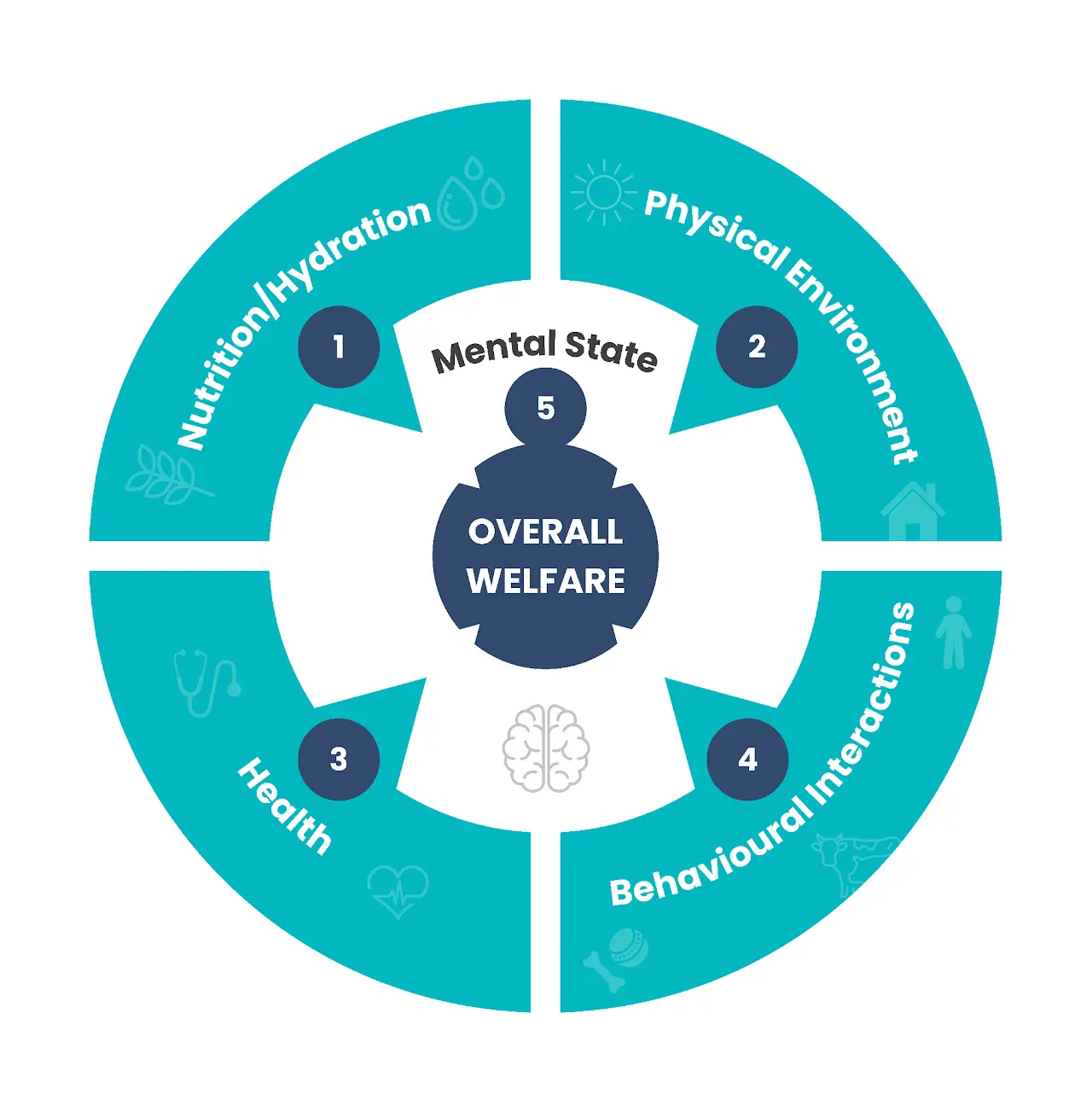
Nutrition
Animals should have continuous access to clean and safe drinking water, together with a nutritionally balanced diet that is appropriate for their species, age, physiological condition, and individual needs.
Environment
The physical environment should promote comfort and accommodate the animal’s biological and behavioral needs. Relevant factors include temperature, substrate, available space, air quality, odors, noise levels, shelter, lighting, and other environmental conditions.
Health
Animals should be maintained in good physical health. Illnesses and injuries should be identified and treated promptly through appropriate veterinary care. Facilities should also implement effective disease-prevention and biosecurity measures to reduce the risk of disease transmission within and between species, as well as between animals and humans.
Behavioral Interactions
Animals should be provided with opportunities to express a broad range of species-appropriate behaviors, including exploring, foraging, playing, resting, and interacting appropriately with their physical environment, other animals, and human caretakers.
Mental State
The first four domains influence the animal’s overall mental experience. When nutrition, environment, health, and behavioral interactions are appropriately managed, animals are more likely to experience positive states such as comfort, curiosity, interest, playfulness, and security. At the same time, negative experiences including fear, hunger, pain, frustration, loneliness, and boredom which can be reduced or prevented.
2. Which Animals Does Animal Welfare Apply To?
Animal welfare applies to individual animals across a wide range of contexts, including wildlife, farm animals and livestock, poultry, companion animals, working animals, and animals used in research. Although specific welfare indicators and management practices vary between species and contexts, the underlying principles remain broadly consistent. Frameworks such as the Five Domains Model can therefore be adapted to assess the welfare of different groups of animals.
Animal Welfare in Farm Animals and Livestock
For farm animals and livestock, good animal welfare is closely connected with sustainable and responsible agricultural production. Appropriate welfare practices can contribute not only to better outcomes for animals, but also to improved productivity, disease prevention, product quality, and the long-term sustainability of farming systems.
Nutrition
Farm animals should receive balanced diets that meet the nutritional requirements of their species, age, and stage of production. Appropriate nutrition supports healthy growth and development, helps optimize production efficiency, and may contribute to improved economic outcomes.
Environment
Housing should be designed according to the biological and behavioral needs of the animals and the size of the herd or flock. Important considerations include appropriate stocking density, adequate space, ventilation, hygiene, temperature, flooring, bedding, and access to suitable environmental resources. Well-designed housing can reduce competition and aggression, improve hygiene and biosecurity, and lower the risk of disease. For example, pigs that are not provided with straw or other appropriate manipulable materials for rooting and exploration may experience frustration and stress, potentially contributing to abnormal behaviors such as tail biting.
Health
Because humans consume food products derived from farm animals, maintaining good animal health is important not only for animal welfare but also for public health. A number of infectious diseases can be transmitted between livestock and humans, including bovine tuberculosis, anthrax, brucellosis, and foodborne infections associated with organisms such as Escherichia coli and Salmonella. Effective disease prevention, veterinary care, vaccination where appropriate, and good biosecurity are therefore essential for both animal welfare and human health.
Behavioral Interactions
Farm animals should be given opportunities to express important species-specific behaviors in order to reduce the physiological and psychological stress associated with intensive or restrictive environments. Positive human–animal relationships are also important. Calm and appropriate handling can reduce stress, whereas rough handling, fear-inducing interactions, or repeated negative experiences may compromise both physical and psychological well-being.
Mental State
When animals receive appropriate nutrition, live in suitable environments, remain in good health, and are able to engage in meaningful behavioral interactions, they are more likely to experience positive mental states. They are also less likely to develop chronic stress, abnormal repetitive behaviors, aggression, or self-injurious behavior. Improved welfare may also contribute to better productivity and product quality.
Animal Welfare for Captive Wildlife
For wild animals living under human care, animal welfare is important not only for the quality of life of each individual animal, but also for the success of conservation programs, rehabilitation efforts, breeding programs, and public education.
Nutrition
Animals should receive nutritionally balanced diets that reflect the natural feeding ecology and physiological requirements of their species. For animals being prepared for release into the wild, providing foods and feeding opportunities that resemble those encountered in their natural environment may be especially important. This can help animals maintain the skills and behaviors necessary for survival following release.
Environment
Enclosures should be designed with reference to the natural ecology, physical abilities, and behavioral needs of each species. Animals should have sufficient space and environmental complexity to express a meaningful range of natural behaviors. Appropriate enclosure design can help reduce stress, prevent negative emotional states, encourage behavioral diversity, and decrease the risk of abnormal or self-injurious behaviors.
Health
Wild animals under human care should have access to timely and appropriate veterinary care. Facilities should also maintain effective biosecurity measures to protect animal health and reduce the risk of disease transmission between individuals, between species, and between animals and humans. Some infectious diseases associated with wildlife can also pose significant zoonotic risks. Effective disease surveillance, prevention, quarantine procedures, and veterinary management are therefore important components of both animal welfare and public health.
Behavioral Interactions
In captive environments, some degree of interaction between humans including keepers, veterinarians, researchers, and other personnel and animals is unavoidable. Positive, carefully managed interactions can support good welfare. For example, cooperative care training can enable animals to voluntarily participate in husbandry or veterinary procedures, helping to reduce fear, restraint, and stress. However, direct human-wildlife contact should generally be carefully controlled and kept to the minimum necessary for appropriate care and management. Excessive or inappropriate contact may create safety risks for both animals and people. It may also reduce an animal’s natural wariness of humans, potentially compromising its ability to survive following release into the wild.
Interactions between animals should likewise reflect the natural social organization of the species. Social species, including many macaques, langurs, and hornbills, may benefit from opportunities to interact with conspecifics and maintain appropriate social relationships. By contrast, naturally solitary species may require separate living areas and greater control over when and how they encounter other individuals.
Mental State
Animals cannot verbally describe how they feel, but aspects of their mental state can often be inferred through systematic behavioral observation together with information about their physical health and environment. When the other four domains are appropriately managed, animals are more likely to display positive, species-appropriate behaviors associated with good welfare. Conversely, persistent abnormal behaviors, withdrawal, aggression, self-injury, chronic stress, or recurring health problems may indicate compromised welfare and highlight the need to examine one or more of the underlying domains: nutrition, environment, health, and behavioral interactions.
3. Animal Welfare in Legislation Around the World
As societies have developed, animal welfare has received increasing scientific, ethical, and legal recognition. Today, many countries have introduced laws or legal provisions addressing animal welfare, humane treatment, or the prevention of animal cruelty. One particularly important development has been the growing legal recognition of animal sentience. In scientific and legal contexts, sentience refers to an animal’s capacity to experience subjective states and feelings, including pain, fear, stress, comfort, and pleasure. Countries including Germany, the United Kingdom, France, Italy, Spain, Canada, Australia, the Netherlands, Sweden, Switzerland, and New Zealand have incorporated recognition of animal sentience or legal recognition of animals’ capacity to suffer into aspects of their legal frameworks.
Since 2014, World Animal Protection has developed the Animal Protection Index (API), which assesses countries according to the strength and scope of their animal protection policies and legislation. The Index considers four broad goals:
Recognition of animal sentience and protection from suffering
This examines whether national legislation recognizes animal sentience and whether fundamental protections such as prohibitions against animal cruelty, which are established in law.
Comprehensive animal welfare legislation
This assesses whether legal protections extend across different categories of animals, including farm animals, animals in captivity, companion animals, working animals, animals used for entertainment, research animals, and wildlife.
Government commitment and institutional support
This considers whether governments have established clear institutional responsibilities, accountability mechanisms, implementation structures, and sufficient resources to enforce animal welfare policies effectively.
Support for international animal welfare standards
This examines whether the animal welfare standards developed by the World Organization for Animal Health (WOAH) have been incorporated into national legislation or policy, as well as government support for broader international animal welfare initiatives.
Animal Welfare Legislation in Vietnam
Vietnam does not currently have a single, dedicated Animal Welfare Act. Nevertheless, principles relating to the humane treatment and care of animals have been incorporated into several areas of Vietnamese legislation, including the Law on Veterinary Medicine (2015) and the Law on Animal Husbandry (2018).
Law on Veterinary Medicine (2015)
Article 21. Treatment of Animals
Organizations and individuals engaged in animal husbandry, aquaculture, or activities involving animals are responsible for:
- Managing, caring for, feeding, and transporting animals in ways appropriate to the characteristics and needs of each species.
- Minimizing pain and fear and ensuring humane treatment during farming, aquaculture, transportation, slaughter, disease control, veterinary treatment, and scientific research.
Organizations and individuals keeping companion animals or animals for biodiversity conservation are also responsible for providing appropriate care, disease prevention, and timely veterinary treatment in accordance with applicable law.
Law on Animal Husbandry (2018)
Article 69. Humane Treatment of Farm Animals
Individuals and organizations engaged in livestock production must:
- Provide housing and sufficient space appropriate to the species.
- Ensure access to adequate, hygienic food and drinking water.
- Prevent and treat diseases in accordance with veterinary regulations.
- Refrain from beating, abusing, or otherwise mistreating animals.
Article 70. Humane Treatment During Transportation
Those responsible for transporting animals must:
- Use appropriate vehicles and equipment that provide sufficient ventilation and minimize injury, pain, and fear.
- Provide adequate food and water during transportation.
- Refrain from beating or abusing animals.
Article 71. Humane Treatment During Slaughter
Slaughter facilities must:
- Provide clean holding areas and access to drinking water while animals await slaughter.
- Minimize fear and pain and refrain from beating or abusing animals.
- Ensure that animals are rendered unconscious before slaughter and prevent them from witnessing the slaughter of other animals.
Article 72. Humane Treatment in Scientific Research and Other Activities
Animals used in scientific research and other activities must be treated humanely in accordance with the principles set out in Articles 69, 70, and 71 of the Law. Humane treatment should also be implemented in ways that respect religious beliefs, cultural traditions, and accepted social values.
FINAL THOUGHTS
In summary, animal welfare is a much broader concept than simply whether an animal is well fed, has shelter, or is free from disease. An individual animal may appear physically healthy while still experiencing poor welfare if its living environment is unsuitable, if it is unable to express natural behaviors, if it is frequently exposed to stress, or if it has limited opportunities to experience positive emotional states. For this reason, welfare assessment needs to consider the animal’s overall quality of life, including nutrition, environment, health, behavioral interactions, and mental state.
Today, animal welfare is no longer viewed as an issue concerning animals alone, or simply as a matter of animal rights. It is increasingly connected to public health, sustainable development, conservation, and human ethical responsibility. From psychological and ethical perspectives, the way we treat animals reflects our capacity for empathy, compassion, and responsibility toward other living beings. Recognizing when an animal is suffering, stressed, or living in unsuitable conditions can influence how we evaluate, choose, and support facilities that keep animals under human care.
In livestock farming and food production, animal welfare is also closely linked to animal health, hygiene, biosecurity, disease control, and product quality. Appropriate housing, adequate nutrition, proper veterinary care, and efforts to minimize stress not only improve animals’ quality of life but can also contribute to reducing disease risks and building more responsible food production systems. In conservation, good welfare helps ensure that rescued, rehabilitated, or reintroduced animals do not merely “survive,” but are given appropriate conditions to recover and express species-appropriate behaviors. Therefore, animal welfare is increasingly recognized as an interdisciplinary issue in which the interests of animals, humans, the environment, and society are closely interconnected.
What I would particularly like to emphasize through this article is that animal welfare is not a standard reserved only for professionals. When we visit a zoo, rescue center, conservation facility, or any other place where animals are kept under human care, the way we observe, ask questions, and choose which facilities to support can also make a difference. Instead of focusing only on whether an animal looks “beautiful,” “cute,” or “friendly,” we can begin to pay closer attention to the conditions in which it lives, whether it is able to express behaviors characteristic of its species, and whether its environment genuinely meets its needs. These are also among the core factors used when assessing the welfare of both farm animals and wild animals under human care.
In the next articles in this animal welfare series, I will explore in greater detail how to recognize certain signs of poor welfare, abnormal behaviors, and the methods used to improve animals’ quality of life in captive environments. Thank you for reading.
Ngan Khanh Tran
ℹ️ Disclaimer
The content published in this article is intended for general informational and reference purposes only. Neither Quite A Lens nor the author makes any representation or warranty, express or implied, as to the accuracy, completeness, currency, reliability, or suitability of the information presented. The content should not be regarded as a substitute for professional advice, diagnosis, or guidance from qualified experts or competent authorities. This article may contain links to third-party websites that are outside the ownership, management, or control of Quite A Lens. Accordingly, we assume no responsibility or liability for the content, subsequent changes, privacy policies, accuracy of information, or practices of any external websites.