


One of art’s enduring purposes is to reflect the society in which it is created. As environmental degradation and climate change have become pressing issues of the 21st century, art is an important medium that invites the audience to think about their roles in the climate crisis while inspiring hope for a different future. Climate-conscious arts do not just depict the environmental crisis but actively grapple with it, using materials, forms, and processes that echo the very systems they critique. Today, I want to share with you the works of American artist Chris Jordan.
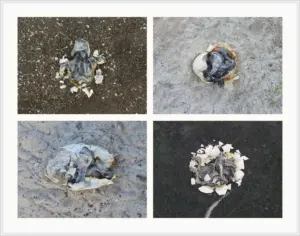
My interest in Chris Jordan’s art began when I saw the image of a bird’s stomach filled with plastics in one of the lectures in my “Introduction to Environmental Studies” class. The photograph showed the carcass of a Laysan albatross chick, its body decomposed enough to reveal the undigested bottle caps, lighters, and fragments of plastic that had accumulated inside it. The chicks die after parents mistake floating plastic debris for food and feed it to them. The photograph comes from “Midway: Message from the Gyre,” Jordan’s visual essay documenting the impact of plastic pollution on albatrosses and their habitat in the remote Midway Atoll in the Pacific Ocean. Jordan’s reflections add a deeper meaning to the work:
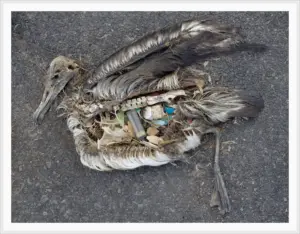
“These birds reflect back an appallingly emblematic result of the collective trance of our consumerism and runaway industrial growth. Like the albatross, we first-world humans find ourselves lacking the ability to discern anymore what is nourishing from what is toxic to our lives and our spirits. Choked to death on our waste, the mythical albatross calls upon us to recognize that our greatest challenge lies not out there, but in here.”
As someone who has worked on campaigns aimed at reducing single-use plastics consumption, I was familiar with statistics about plastic pollution. But seeing the consequence of plastic pollution embodied in the tiny body of an innocent animal made the problem feel more real. Questions started racing in my head: “Where did this piece of plastic come from, and how did it travel from someone’s everyday life into the body of a bird thousands of miles away? How many people realize that something as ordinary as a bottle cap could become part of an animal’s final moments? Why have we built a society so dependent on disposable materials, and what prevents us from imagining alternatives? How much of this crisis is rooted not only in individual choices, but in a larger culture of consumption that shapes the way we live?”
Working at the intersection of consumerism and climate change, Chris Jordan sheds light on how our daily consumption habits have far-reaching effects on the ecosystem. His work asks us to look beyond individual objects and instead confront the systems and lifestyles that produce them. This sentiment is perfectly captured by another Chris Jordan’s project named “Running The Numbers: Portraits of Human Mass Culture (2014 to 2018).” This series uses photography to examine large-scale patterns of human consumption through the stark language of numbers. Each piece visualizes a single mass-scale statistic: the volume of chemical pesticide spread across global soils in a day, the quantity of tuna pulled from the oceans in fifteen minutes, the number of cigarette butts discarded into the environment every second, among others.
For a full visual effect, please visit Chris Jordan’s website: https://www.chrisjordan.com/Running-the-Numbers/1/thumbs
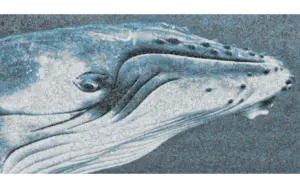
One of the things that struck me most about these images was their sheer magnitude. For example, seeing a print depicting 400,000 plastic bottle caps is both awe-inspiring and unsettling. After all, the statistics conveyed in the image only demonstrate the level of human consumption in minutes or hours.
What strikes me most, looking at these two projects side by side, is how differently they mobilize the same argument. Midway works through intimacy: one bird, one death, photographed up close and left to speak for itself. Running The Numbers, on the other hand, works through dissolving individual items into pattern and texture. Both of these works invite discomfort, but they can also be productive. They relate to my feelings about dealing with climate change. Before studying environmental studies and getting involved in environmental work, I often felt insignificant and hopeless in the fight against climate change. Yet, acquiring knowledge is one of the best ways to feel hope about what we can do. I believe that, just like studying environmental issues, Jordan’s artworks make environmental concerns visible and put each individual’s role in the grand scheme of things into perspective. Facing disastrous environmental threats might be unsettling, but only by understanding their root causes can people make a difference.
3 Lessons I learned from climate art:
- Arts can be an effective way to raise awareness of environmental problems. Whether through paintings, music, or photography, arts bring out the human dimensions of environmental problems and evoke emotions in ways that data alone cannot achieve. Thus, arts encourage empathy, and people are more likely to take action on issues they feel connected with.
- By immersing ourselves in arts, we are compelled to think about the climate crisis through a different lens, one that critically examines individual and collective roles in our current environmental problems. By allowing us to reflect on the big pictures while not forgetting the small details, arts empower us to understand that these two dimensions are inherently connected: that the accumulation Jordan depicts is made up of choices as small as a single-use cup, and that a single death like the albatross’s is itself a symptom of something vast.
- The understanding acquired through climate arts is a source of agency. Once we understand our place in the climate crisis, we have greater insights into how we can change it. Art does not tell us which of these to pursue, but it makes clear that we are already implicated, and being implicated is where agency begins.
So, go look at climate arts. Listen to a song. Write a poem. Draw a painting. Visit a gallery. Let your creativity take charge. Let yourself feel the urgency, the grief, and the possibility of change. Before we are able to change the planet, we must be able to see the world, and ourselves, differently. And that change can begin with art!
Written by: Tamira Le
Last edit: August 6, 2026