



If you were like me and enjoyed watching Hong Kong TVB crime and detective dramas, you may be familiar with series such as Forensic Heroes, Detective Investigation Files, The Mind Games, and so forth. Fans of Hollywood films may also know Split (2017) and other productions built on similar ideas.
One thing these films and television series have in common is that they are inspired by Dissociative Disorders (DDs), especially Dissociative Identity Disorder (DID), a condition that is still commonly referred to by the public as “multiple personality disorder.”
DID is often introduced into a film or episode as a tool for creating suspense or delivering a shocking plot twist. Characters with DID are frequently written as having at least one “dangerous” or “insane” identity, which is extremely violent and capable of committing brutal murders. These portrayals have led many people to assume that individuals with DID are naturally unpredictable, violent, or dangerous (series killers). Yet few, if any, of these stories are based on the actual experiences of people who live with DID.
This would be far less troubling if such portrayals caused no real harm. In reality, however, they have contributed to deep-rooted stigma and misunderstanding surrounding the condition. Many people with DID may feel unable to disclose their diagnosis because society is still not safe or accepting enough for them to speak openly. They may be judged based on the image created by films, which often portray them as violent criminals or murderous villains. This stigma can make it harder for them to find work and may be used against them in legal situations, turning their diagnosis into a perceived vulnerability.
The truth is:
There is no empirical evidence suggesting that people with dissociative disorders (DDs) are more likely to commit murder than members of the general population.
Many people with dissociative disorders have histories of severe childhood abuse, maltreatment, psychological trauma, or other deeply distressing experiences.
People with DID are more likely to harm themselves and face a heightened risk of suicidal thoughts and behaviors.
As someone who enjoys research, I believe that these exaggerated portrayals by filmmakers can also hinder scientific progress. They may make it more difficult for researchers to recruit sufficiently large samples when studying these disorders.
For this reason, I want to discuss the topic here so that those who are interested can gain a clearer understanding of DDs, particularly DID, which is frequently used as a dramatic element in films and television.
So, is DID really as dangerous as it is often portrayed on screen? And what about the other dissociative disorders? Let us take a closer look at what the evidence actually shows.
WHAT ARE DISSOCIATIVE DISORDERS?
Dissociative disorders are a group of mental health conditions characterized by disruptions in consciousness, memory, identity, emotions, perception, motor control, and even behavior. Their symptoms are often associated with psychological trauma and may develop as part of the nervous system’s protective response during or after prolonged, overwhelming, or distressing experiences.
TYPES OF DISSOCIATIVE DISORDERS
According to the Diagnostic and Statistical Manual of Mental Disorders, Fifth Edition, Text Revision (DSM-5-TR), dissociative disorders are classified into five categories:
- Dissociative Identity Disorder (DID)
- Dissociative Amnesia
- Depersonalization/Derealization Disorder
- Unspecified Dissociative Disorder
- Other Specified Dissociative Disorder
Note: The DSM-5-TR is a diagnostic manual for mental disorders published by the American Psychiatric Association (APA). Its framework primarily reflects the cultural and clinical contexts of the United States and other Western countries. Readers in other parts of the world may also wish to consult the World Health Organization’s International Classification of Diseases (ICD).
However, most articles published here will primarily refer to the DSM-5-TR, as I am currently studying in the United States and mainly exploring research within the U.S. academic and clinical context.
However, only (1), (2), and (3) are considered the three core dissociative disorders. Categories (4) and (5) are not separate or newly identified disorders. Instead, they are additional diagnostic categories used by the DSM to account for dissociative symptoms that do not fully meet the criteria for a specific diagnosis.
One category is used when a person shows clear dissociative symptoms but does not meet the full diagnostic criteria for any of the three specific disorders listed above. The other may be used provisionally when there is not yet enough information to make a more specific diagnosis. I will explain these categories in greater detail below as we examine each type.
Therefore, this article will focus primarily on the three core dissociative disorders, presented here in a general progression from lower to higher levels of severity:
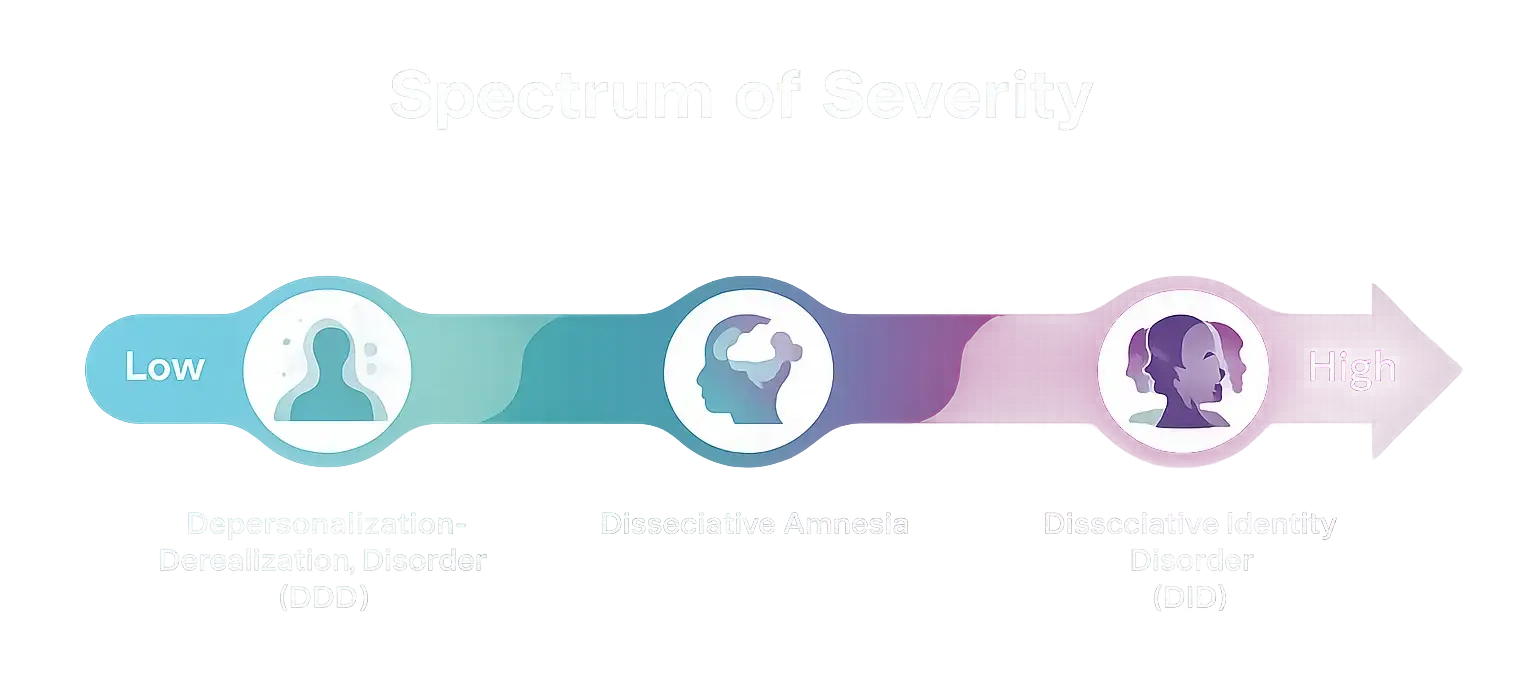
Type 1: Dissociative Identity Disorder (DID)
DID was previously known as multiple personality disorder. People with DID typically experience at least two distinct identity states or different senses of self. Epidemiological studies estimate that DID affects approximately 1-1.5% of the population, although this figure may vary depending on the research methodology and the level of clinical recognition. The prevalence of DID is also believed to be similar among men and women.
Common manifestations and diagnostic criteria
- The person experiences a disruption of identity involving the presence of at least two or more “alters” – distinct dissociative identity states.
- The person may experience unexplained gaps in memory involving everyday events or important personal information. These memory gaps cannot be accounted for by ordinary forgetfulness.
- The symptoms are not caused by substance use, such as alcohol or drugs, and cannot be explained by another medical condition or illness.
- The disturbance is not part of a broadly accepted cultural or religious practice. For example, experiences involving spirit possession, mediumship, or trance states within an accepted religious context should not automatically be diagnosed as DID.
- The symptoms cause significant distress or impair the person’s functioning and quality of life in major areas, including work, relationships, and everyday social activities.
Switching and alternate identities in DID
Switching occurs when different identity states take turns assuming control. It is often triggered by a stressful event or situation, after which the identity state perceived as best able to cope with the current threat or concern may emerge.
The switching process varies considerably from one person to another. In some people, switching occurs so smoothly that it is difficult to notice. In others, the person may suddenly appear sleepy, disconnected, or mentally absent. Some individuals may also display strong and clearly observable physical movements during a switch.
There are three main patterns of relationships among identity states:
- Mutually amnesic relationships: None of the identity states are aware of the existence of the others.
- Mutually cognizant patterns: Each identity state is aware of the others. Some identities may know about and interact with other identities within the person’s internal world.
- One-way amnesic relationships: Some identity states are aware of other identities, but the awareness is not mutual. The identities that possess this awareness are often described as silent observers. This is considered the most common relationship pattern.
Treatment goals
A common treatment goal is to gradually integrate the dissociative identity states until final fusion is achieved. This is typically a long-term process in which the separate identity states gradually become unified into a single, cohesive identity. However, some people with DID do not wish to pursue full fusion. In such cases, therapists should respect their preferences and provide appropriate psychological treatment aimed at:
- increasing internal communication and cooperation among identity states;
- reducing psychological symptoms;
- helping the person confront and process past trauma; and
- improving their overall quality of life.
More information:
Detailed reference: DSM-5-TR, pp. 725–738
Video depicting a well-known DID case: The Three Faces of Eve
Type 2: Dissociative Amnesia
Movies featuring characters with memory loss may easily remind you of dissociative amnesia. However, in real life, the condition has both similarities to and important differences from what is commonly portrayed in films. Dissociative amnesia is estimated to affect approximately 1.8% of the population. Several studies also suggest that women are about twice as likely as men to be diagnosed with the disorder.
Common manifestations and diagnostic criteria
(1) The person is unable to recall important information about themselves (autobiographical information), usually related to traumatic or highly stressful events or experiences. The key distinction is that this memory loss is inconsistent with ordinary forgetting.
Dissociative amnesia commonly appears in the following forms:
- Localized amnesia: The person is unable to recall events that occurred during a specific period, while memories from before and after that period remain intact. It may feel as though a segment of the person’s timeline has “disappeared.” This is the most common form. The period of memory loss may be brief, such as the time immediately surrounding a traumatic event, or may extend over months or years when the trauma occurred over a prolonged period.
- Selective amnesia: The person can remember some aspects of an event but cannot recall all the details of what happened during that event or period.
- Generalized amnesia: The person experiences a complete loss of memory concerning their entire life, including their personal identity.
(2) The symptoms cause significant distress or impair the person’s ability to work, interact socially, and participate in other important activities.
(3) The condition is not caused by substances, such as alcohol, recreational drugs, or medications, and cannot be attributed to a neurological or medical condition, such as epilepsy, the effects of a head or brain injury, or another neurological disorder.
(4) The memory disturbance cannot be better explained by another disorder, such as dissociative identity disorder, post-traumatic stress disorder, or a neurocognitive disorder.
Although uncommon, some people with dissociative amnesia may also experience dissociative fugue. In this state, the person not only loses access to their personal identity and details of their past but also travels or wanders away to an entirely different place.
A dissociative fugue may be brief or more severe. It may last for several hours or several days before ending abruptly. Most individuals eventually recover most or all of their memories and do not experience another episode. However, in some cases, the lost memories may not be fully recovered.
Treatment goals
Some clinical sources suggest that many people with dissociative amnesia may recover their memories spontaneously without intensive treatment. Although I have not found reliable data specifying the percentage of patients who recover without treatment, spontaneous recovery appears to be widely recognized in clinical practice.
Why is there so little statistical evidence? I believe there may be two main reasons: (1) There may not yet be a sufficiently large sample for extensive epidemiological research; (2) As mentioned above, the symptoms may resolve on their own. As a result, some individuals never seek treatment and are therefore not included in clinical statistics.
Nevertheless, some patients still require treatment, either because they urgently wish to recover their memories or because they need help with other associated difficulties. In such cases, the therapist’s goal is to help bring the memories back into conscious awareness so that the patient can process both the memories and the emotions connected to them.
Depending on the individual case, treatment may involve hypnosis or related hypnotic techniques, psychotherapy, medication, or a combination of these approaches.
More information:
Detailed reference: DSM-5-TR, pp. 739–749
Video depicting a case of dissociative fugue: Dissociative Fugue
Type 3: Depersonalization-Derealization Disorder (DDD)
People with this disorder may feel detached from the reality of their surroundings or disconnected from themselves as though they have become observers of their own lives rather than the people actually living them. Studies estimate that the prevalence of DDD in the general population ranges from 0% to 1.9%. The disorder is believed to affect men and women at approximately equal rates.
Common manifestations and diagnostic criteria
(1) The person experiences persistent or recurrent episodes of depersonalization, derealization, or both.
- Depersonalization is an experience of feeling detached from oneself. The person may feel as though they are an outside observer watching themselves, as if they are unreal, emotionally numb, or disconnected from their body.
- Derealization is an experience of feeling detached from the external world. The person may feel that everything around them is unreal. Familiar people may seem strange or distant, and their perception of space, distance, the size of objects, or even time may feel distorted.
(2) The symptoms are not caused by substance use, such as alcohol or recreational drugs, and cannot be attributed to another medical condition or illness.
(3) People with DDD remain aware that these sensations and experiences are unusual and are not actually occurring in reality. In other words, their reality testing remains intact. This helps distinguish DDD from other mental disorders, such as schizophrenia, panic disorder, depressive disorders, PTSD, or another dissociative disorder.
(4) The symptoms cause significant distress or impair the person’s functioning and quality of life in major areas, including work, relationships, and everyday social activities.
(5) High levels of stress and psychological trauma are among the most common triggers associated with the disorder.
Treatment goals
Receiving an accurate diagnosis of DDD may itself help reduce symptoms because it can lessen the person’s anxiety about the confusing and frightening experiences they are having.
At present, there is limited evidence to guide the treatment of DDD specifically. Treatment therefore commonly focuses on co-occurring conditions, such as anxiety and depression, using different forms of psychotherapy. Medication may also be used when appropriate, depending on the individual patient’s condition.
More information:
Detailed reference: DSM-5-TR, pp. 749–756
Video about a typical case of DDD: My Condition That Makes Me Feel Like I’m Dreaming All the Time
CONCLUSION
Ultimately, I hope you have found your answer to the question posed at the beginning of this article: “Are people with dissociative identity disorder killers or victims of the screen?”
Perhaps what we need is not to stop telling stories about DID or stop making films about it, but to tell these stories more responsibly and portray the disorder more ethically. Such portrayals should be grounded in scientific knowledge, developed in consultation with professionals, and informed by the lived experiences of people with the disorder. After all, when the screen fades to black, the stigma it creates continues to exist. And those who must bear its consequences in real life are not the fictional characters, but people who are actually living with DID.
Disclaimer: This artical has been carefully compiled and reviewed, with references cited throughout each article. However, knowledge in the field of psychology continues to evolve as new scientific findings emerge, and differences in professional perspectives may exist. Readers are encouraged to approach the content with care, cross-verify information, and stay informed through reliable and regularly updated sources. The content is intended solely for informational purposes and to present different perspectives. It should not be used as a basis for self-diagnosis, prescribing medication, or self-treatment. If you are experiencing psychological or mental health concerns, please consult a psychiatrist, psychologist, or other qualified mental health professional for appropriate guidance and support.