


I love visiting museums since I was a kid. For me, they are one of the best places to really feel the definition of time, the different ecosystems and cultures, and to connect with a piece of the past with my own eyes. So wherever I go, I always look for local museums and try to fit a few into my trip.
On my visits to some cultural, history, and natural museums in a few American cities and national parks, I picked up some observations I found interesting; and I would love to share them here.
Museums Can Promote Reflection Spirits and Learn From the Past
Most of the museums I visited left a strong impression on me: they are willing to look at themselves honestly and admit past mistakes. And not just mistakes in the history of the land but mistakes in how the museum itself was built, like how objects were collected and how exhibits were designed.
One idea that really stuck with me came from the Natural History Museum of Los Angeles: whether museums should keep building dioramas – those three-dimensional models that recreate “typical” features of a subject, like clothing, tools, and living environment. Dioramas are easy for visitors to understand and they create a sense of diversity and richness. But they also freeze their subject inside the viewpoint of a small group of people, sometimes those who do not even belong to the community being shown. And they can leave visitors with ideas that may no longer match the reality of those communities today.
Below is an example: a diorama showing a meeting between Dutch colonists and the Lenape, one of hundreds of Native American tribes, that used to be on display at the American Museum of Natural History in New York.
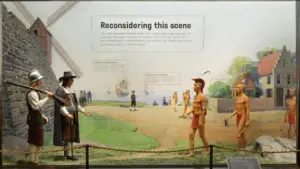
The way the Lenape are shown in this diorama has been criticized for getting the history wrong and for repeating familiar stereotypes: Native people bare-chested, in loincloths, with feathers in their hair.
There has been a lot of work in recent years to raise awareness about Native Americans. Still, many of us who have not had much contact with these communities or much information about them are often carrying stereotypes we picked up without noticing. And when we show a narrow, stereotyped version of a group of people, or even practice cultural appropriation activities, we can cause real misunderstanding and real hurt, even when we mean well. The Washington Commanders, a professional football team in the National Football League (NFL), is one example. In 1933 the team took the name Washington Redskins, with a mascot based on a Native American man wearing a feather headdress. Many Native communities were upset and felt offended by it. Research by Stephanie Fryberg, a professor at the University of Michigan, found that when Native teenagers are exposed to Native sports mascots, it can damage their self-esteem, lower the goals they set for themselves, and weaken their pride in their community and their belief in it. After years of public pressure, the team had no way but changed its name, to the Washington Football Team in 2020 and then to the Washington Commanders in 2022.
The debate about dioramas was new to me. And it made me realize I had done the same thing myself unknowingly. There have been times when everything I pictured about ethnic minority communities in Vietnam came from images in a museum or from whatever materials happened to reach me instead of learning about them as they live now, in all the complicated ways a diorama could never show. It got me thinking about how stereotypes form, how they get reinforced, and how museum education might be able to shift them, at least a little.
Engaging Communities to Speak for Themselves
When I visited the National Museum of the American Indian and the National Museum of African American History and Culture, I noticed that most of the staff came from the communities presented in these museums. They were very nice, welcoming, and always ready to answer visitors’ questions whenever they could.
One time I was standing for a long while in front of a tipiti – a tool used to squeeze the liquid out of cassava which is common among Indigenous communities in the Amazon basin, googling to figure out how it worked. A staff member came over, asked what I was curious about, and explained how her community use the tipiti in cooking. Then she told me about a few other objects in the museum that are also connected to her community. Her kindness and open sharing made me truly grateful. More than ever, I could feel a culture that was alive and right there in front of me, not something sitting quietly behind glass.
Museums Are Not Only About the Past but A Part of the Present
At the Mesa Verde ruins and the visitor center at Mesa Verde National Park in Colorado, one message came up again and again: the Indigenous communities who once lived here are still living now.
Even though we physically moved away, the spirits of my ancestors are still here. If you stop for a minute and listen, you can hear the children laughing and the women talking. You can hear the dogs barking and the turkeys gobbling. You can hear and feel the beat of the drums and the singing. You can smell the cooking fires. You can feel their presence, their warmth, their sense of community.
TJ Atsye, Laguna Pueblo
Museums are not just places that preserve heritage and tell you one fixed version of history, with objects in glass cases and a few lines of text next to them. They are actively using new ideas, new reflections, and new ways of displaying things to make the experience richer and more interesting.
A museum can be a good place to start learning about something. But no matter how much work goes into it, a museum can only ever hold one or a few slices of a subject’s complicated history and life. That is a reminder of how important it is to keep asking questions and keep learning in the present, outside the museum walls, so you can see things from more than one angle. I keep reminding myself that there are probably still so many stories that have never been told, never written down, never even briefly shown in an official public exhibition space. So when you get the chance to visit a museum, you should try talking to local people or the people who work in that museum – the people who are actually living and continuing the history that the museum talks about. Sometimes their answers can hold experiences, memories, and points of view that have not even been presented inside a museum yet.
Duyen Nguyen
Disclaimer:
Although we have taken all possible measures to ensure the accuracy of the information contained in this writing, we shall not be liable for any damage caused to users by the use of the information contained herein.