


Did you switch your light on, charge your phone, or microwave your food this morning?
For most people, the answer is probably yes. Yet, these ordinary acts that you often take for granted draw from a complex system that shapes not only how energy is produced but also what impact energy production has on the planet. Far from being a neutral technological system, the generation of electricity reveals important insights into questions that sit at the heart of the debate about the climate crisis: who pays, who pollutes, who holds the power. This is where the idea of community energy becomes important. In this article, we’ll explore what community energy is, why it matters, and how it offers a different vision for powering our future.
- What is Community Energy?
Community energy is a new way of thinking and implementing the geographies of producing, living, and working with energy as a response to climate change problems and decarbonization challenges (Creamer et al., 2018, p. 1). Community energy encompasses a wide range of projects, from solar farm collectives in Nepal, neighborhood fuel poverty alleviation schemes in the UK to wind cooperatives in Denmark. Because of this diversity, scholars often use a definition of community energy that fits the scope and agenda of their research.
At the most basic level, what distinguishes community energy from non-community energy projects is “the level of participation and involvement of community members in the process of developing a project and/or the outcomes of the project” (Creamer et al., 2018, p. 1). While some scholars place an emphasis on the technical aspects of decentralized energy generation, others focus more on the social and political dimensions, such as the absence of governmental or big company participation, collective ownership, or the benefits distributed to the community (Brummer, 2018, p. 189). Additionally, the concept of community is not defined by geography alone. Community energy can be organized around shared interests, identities, and sectoral or virtual networks, as exemplified by online energy-saving communities (Heiskanen et al., 2010, p. 7589). Keeping in mind these nuances, this article will define community energy as any activity involving the generation or distribution of heat or electricity that includes the participation of local communities.
The diversity of definitions also extends to variations in project scope and implementation model. Community energy engages in a wide spectrum of activities, “including electricity and heat generation (from a range of sources), energy efficiency and demand management, collective purchasing, storage, transport, and education and awareness raising” (Creamer et al., 2018, p. 3).
- Community Energy in Action
Let’s take a look at some community energy initiatives worldwide to have an idea of what they entail.
In the UK, South East London Community Energy (SELCE) is a member-led co-operative that offers “solar power, home energy support, and retrofit advice to homes and community buildings.” SELCE operates through community share offers to install renewable energy and sell clean energy at reduced rates. Investors receive 3-4% dividend, and any surplus is allocated to fuel poverty alleviation projects that offer one-on-one advice to households in need.
In the US, Power Forward Communities, the first national program to finance home energy efficiency upgrades at scale, is a prime example of sectoral-based community energy that utilizes the existing network of large NGOs to make energy efficiency more affordable while creating jobs and other social benefits. Another model of community energy that is pretty popular in the US is community or “shared” solar systems, which refers to a grid-connected renewable energy facility whose generated electricity is credited proportionally to subscribing members rather than a single owner (Peters et al., 2018, p. 357). As of June 2024, community solar operations in the US generate 7.87 GW in capacity, spanning across 44 states with over 3400 active projects.
In Global South countries with grid access issues, community energy initiatives take advantage of decentralized renewable energy to power their homes. For instance, Light of Hope PH is a social enterprise that integrates renewable energy and Internet of Things technologies to provide energy access to off-grid island communities in the Philippines. Drawing on community input, Light of Hope PH repurposes plastic bottles and turns them into solar night lamps and invents solar-powered Cloudgrid for charging purposes.
These examples illustrate that community energy is not a single model. Rather, it is a broad movement united by a common principle: empowering communities to play a meaningful role in shaping their own energy futures.
- How Did We Get Here? How did Energy Become Centralized?
To understand why community energy has emerged, we first need to understand how today’s energy system came to be.
Since the 1980s, there has been a shift towards competitive energy markets as the dominant framework in energy governance across the world. Specifically, many governments have pursued a strategy of state-led energy liberalization programs, reflecting the neoliberal belief that reduced public ownership and increased competition would bring about a more efficient energy system (Eadson and Foden, 2019, p. 23). The state played a pivotal role in facilitating this process. In the United States, for example, energy regulation in the 19th century took the form of local governments granting private companies monopoly franchises in exchange for oversights over rates and services (Hartman, 2016). Back then, consumers would purchase electricity from a local utility in their area, which provided electricity through its own delivery system.
The passing of the Public Utility Regulatory Policy Act in 1978 represented the first step toward energy deregulation. The law encouraged competition by “requiring utilities to buy power from lower-cost independent producers,” thus allowing customers to choose their electricity supplier in the wholesale energy market (Hartman, 2016). The Energy Policy Act of 1992 gave the Federal Energy Regulatory Commission (FERC) greater control over granting transmission access to independent electricity producers and energy generating companies that were not part of the original monopoly utilities that owned access to transmission lines. In 1999, FERC encouraged utilities to join an independent system operator (ISO) and regional transmission organization (RTO) to smooth out the process of transmission planning and operation while ensuring grid stability and expansion. Today, these regional system operators manage more than two-thirds of the electricity generated in the US (Hartman, 2016).
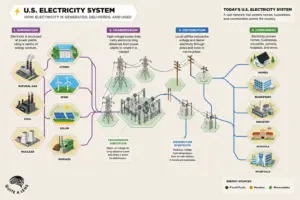
The result is the system many people live with today: electricity is generated in large, centralized facilities, managed by regional grid operators, and delivered to consumers through local utility companies. Most people have little knowledge of where their electricity comes from, or any meaningful influence over how it is produced.
- When the Centralized Energy Market Fails
Yet, despite the idealized vision of a self-regulating energy market, the centralized energy system has failed in two fundamental ways.
Firstly, the system has produced negative externalities with regards to social and environmental costs. The heavy reliance of the US energy system of fossil fuel, which is predicted to constitute 71% of total domestic energy production in 2050, has generated greenhouse gas emissions that contribute to air pollution, environmental degradation, and global warming. Additionally, the risks and benefits associated with electricity generation are not distributed evenly, with marginalized populations being disproportionately exposed to the environmental injustices that come with fossil fuel extraction and combustion.
Secondly, centralized energy markets have resulted in market instability, as exemplified by problems such as unclear pricing systems, exorbitant prices, lack of transparency, and low customer trust in energy service providers (Eadson and Foden, 2019, p. 23). In some places, market failures mean the inability of the state to provide energy access to its citizens. According to the International Energy Agency, approximately 730 million people globally still lacked access to electricity in 2024.
These problems raise an important question: Is there another way to organize our energy system? Community energy emerged as one answer to that question.
- Community Energy Pushback
The push for community energy globally could be considered as a pushback against the market failures of centralized energy systems. Community energy can create new forms of competition in energy production, distribution, storage and supply; serve as a site for technological and social innovation; foster community awareness of energy efficiency and climate change issues; and provide a space of experimentation for alternative economic development models that are decentralized and rooted in the community (Coozi et al., 2025). In this sense, the construction of the centralized energy market and the emergence of the community energy movement represents what Polanyi called a “double movement,” which is characterized by the dialectical conflict between “a movement favouring the marketization of society and a movement aiming at social protection” (Eadson and Foden, 2019, p. 24).
The making of the centralized energy market is a top-down process, since the state laid down the foundations for market institutions to take root and flourish. In response to the state-led process of energy marketization, community energy initiatives aim to turn the passive energy consumers into active agents with greater control over how their energy is produced, managed, and distributed. The social protection dimension of community energy goes beyond protecting individuals from fluctuating energy prices or environmental harm to encompass ideas about democratic participation, social equity, and environmental sustainability. By recognizing the market as a social product shaped through everyday discourse and practice, community energy seeks to reconfigure the relationship between the individual, the state, and the market through challenging the prevailing assumptions that a centralized energy market is the best way to provide an essential public good. Community energy provides a different vision of how to organize the market, not through private monopolies and top-down authority but through community-based, button-up initiatives that enhance social cohesion, innovation, and the values of the community.
Rather than rejecting markets altogether, community energy asks whether markets can be organized differently. Can electricity be generated more efficiently? Can local communities share in the economic benefits of renewable energy instead of simply hosting the infrastructure? Can energy become something people collectively shape rather than merely consume?
In the next issue, we will move from theory to practice by examining how community energy projects actually operate on the ground.
References
Brummer, V. (2018). Community energy – benefits and barriers: A comparative literature review of community energy in the UK, Germany and the USA, the benefits it provides for society and the barriers it faces. Renewable and Sustainable Energy Reviews, 94, 187–196. https://doi.org/10.1016/j.rser.2018.06.013.
Coozi, L., Diarra, N., Roge, A., Idini, B., & Jongejans, A. (2025, October 9). Access to electricity stagnates, leaving globally 730 million in the dark. IEA. https://www.iea.org/commentaries/access-to-electricity-stagnates-leaving-globally-730-million-in-the-dark.
Creamer, E., Eadson, W., van Veelen, B., Pinker, A., Tingey, M., Braunholtz‐Speight, T., Markantoni, M., Foden, M., & Lacey‐Barnacle, M. (2018). Community energy: Entanglements of community, state, and private sector. Geography Compass, 12(7). https://doi.org/10.1111/gec3.12378.
Eadson, W., & Foden, M. (2019). State, community and the negotiated construction of energy markets: Community Energy Policy in England. Geoforum, 100, 21–31. https://doi.org/10.1016/j.geoforum.2019.02.006.
Hartman, D. (2016, August 2). Federal Power Act and organized electricity markets. R Street Institute. https://www.rstreet.org/research/federal-power-act-and-organized-electricity-markets/.
Heiskanen, E., Johnson, M., Robinson, S., Vadovics, E., & Saastamoinen, M. (2010). Low-carbon communities as a context for individual behavioural change. Energy Policy, 38(12), 7586–7595. https://doi.org/10.1016/j.enpol.2009.07.002.
Peters, M., Fudge, S., High-Pippert, A., Carragher, V., & Hoffman, S. M. (2018). Community Solar Initiatives in the United States of America: Comparisons with – and lessons for – the UK and other European countries. Energy Policy, 121, 355–364. https://doi.org/10.1016/j.enpol.2018.06.022.
Written by: Tamira Le
Last updated: August 5, 2026
Disclaimer: This article is intended as an introductory overview of community energy and reflects my own interpretation of the academic literature and examples cited. Community energy is a broad and evolving concept, and the definitions, models, and perspectives presented here are not intended to represent every approach to community energy.