


The article below recounts part of my experience studying abroad in the School of International Training’s International Honors Program in Climate Change: The Politics of Food, Water, and Energy Justice. As part of the program, we travelled to San Francisco, Morocco, Nepal, and Ecuador to learn how communities around the world are experiencing and responding to climate change.
___________________________
The flight skidded on the runway. After a short 35-minute flight from the capital Quito, we finally arrived at Coca, the gateway to the Ecuadorian Amazon Rainforest. As I stepped off the plane, a wave of tropical heat hit my face, one that was starkly different from the cool, crispy air of Quito’s high-altitude equatorial climate.
No sooner had we arrived than we handed over our large bags to be ferried by canoe to our lodge for the night. Moments later, we were hurried onto a large bus, the next leg of our journey already underway. Waiting for us was Hector, an Indigenous Amazonian environmental advocate and our guide for the day’s toxic tour, who greeted us with a warm smile.
Officially known as Puerto Francisco de Orellana, Coca has been home for indigenous Amazonian peoples for centuries. The history of the region long pre-dates the era of Spanish conquistadors. The city itself was relatively new, gaining canton status in 1969. It was with the extraction of oil in the Amazon Rainforest in the 1990s that completely transformed the city into a bustling frontier town. As settlers and oil companies arrived, roads were built and shops were established.
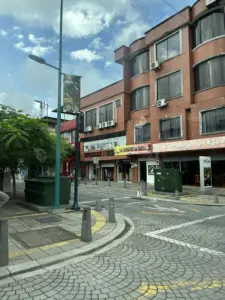
The bus carried us along paved roads that cut through the rainforest. One consequence of oil extraction that was not talked about enough was the cutting down of trees so that oil companies could access drilling sites situated deep in the middle of the forest. These roads not only fragmented the already-fragile ecosystem but also opened previously remote areas to settlement, logging, and further development.
Holding nearly one-fifth of the world’s recently discovered oil and natural gas reserves, the Amazon has become the new frontier for the global fossil fuel industry. In Ecuador, oil extraction began in the early 1920s, and production was significantly ramped up in the 1970s following the discovery of a rich oil field beneath the Amazon rainforest, turning Ecuador into an oil-producing country. Today, oil contributes to more than 7% of the country’s GDP.
Yet as we travelled deeper into the Amazon, the transformation brought by the oil industry was visible in places where there was no oil well in sight.
The Roads Oil Left Behind
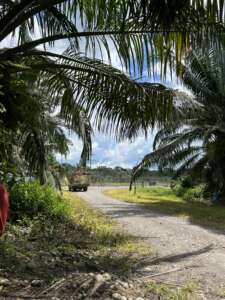
As the roads led deeper into the rainforest, all I saw was nothing but orderly rows of oil palm trees stretching into the distance. Trucks laden with freshly harvested African oil palm fruits slowly made their way through the gravel road. By clearing roads to gain access to drilling sites, the oil industry paved the way for new waves of agricultural expansion, particularly large-scale oil palm plantations. Now amongst the top 10 palm oil-producing countries, Ecuador has converted an area the size of 30,000 football pitches into palm monocultures in the Northern Ecuadorian Amazon region.
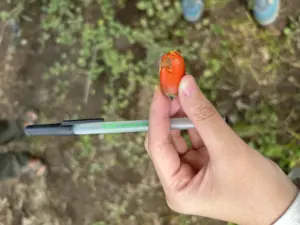
The bus stopped at the side of the road next to patches of palm oil plantation. Hector encouraged us to pick up the palm oil pulp that littered the ground. Immediately after I pressed on the pulp, an orange oil oozed out of the squeezed fruit and seeped into my fingertips. Sticky and richly pigmented, it stained my skin almost instantly. The harvested fruit is processed into palm oil, one of the world’s most widely used vegetable oils, found in countless everyday products ranging from packaged foods and cooking oils to cosmetics, soaps, detergents, and increasingly, biofuels. The creation of a palm oil monoculture exacerbated the already fragile ecosystem that threatened the intricate web of life that once populated the lush forest. As I stood there looking at the stretch of palm oil plantation, I could not help but wonder how our daily consumption habits had come at such devastating ecological price.
But if the palm plantations revealed how oil development could transform what grew above the ground, the next stop on our toxic tour would show us what decades of extraction had left beneath it.
Beneath the Surface
Soon, the palm plantations gave way again to another unmistakable sign of the oil economy. As our bus reached deeper into the forest, I saw oil pipelines that cut through the vast expanse of the forest. These oil pipelines stretched out over hundreds of kilometers, cutting through the Amazon and climbing over the Andes all the way to the Pacific coast. From the roadside, the oil pipeline appeared almost as another part of the landscape. In reality, however, they brought disastrous consequences to life in the forest.
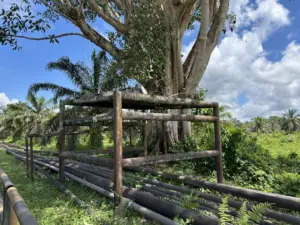
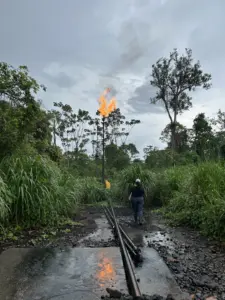
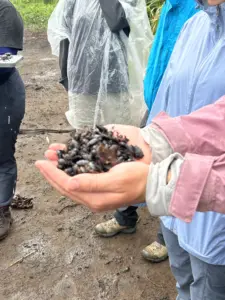
In particular, spills posed a grave problem to the Amazon rainforest. For decades, the rivers of the Ecuadorian Amazon became the dumping ground for the oil industry. Between 1964 and 1990, Chevron discharged more than 16 billion gallons of toxic wastewater into rivers and streams, spilled an estimated 17 million gallons of crude oil, and left behind hundreds of unlined waste pits carved into the rainforest floor.
The toxic tour that we were going on was an important part of exploring the Ecuadorian Amazon Rainforest. It revealed the extent to which the world’s demand for oil was exacting its toll on those people who benefited least from it. Our bus stopped in front of a small plot of residential land that looked almost too normal. The owners of the land were going about their daily life. Cacao trees intertwined with banana trees. If no one had told me otherwise, I would never have guessed there was anything unusual about the place.
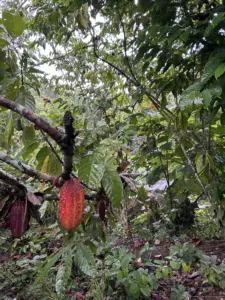
Hector took out a shovel and began digging into the ground. Without saying much, he drove the blade into the earth. It took only a few scoops, no more than 20 centimeters deep, before he lifted it back up. The metal blade was coated in a thick, black, oily sludge. I put my nose close to the shovel and immediately recoiled at the oil smell. It was a sharp, unmistakable scent of petroleum that seemed impossible to reconcile with the lush rainforest surrounding us.
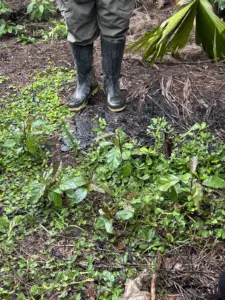
The land that people lived on, the water that they drank, and the food that they ate, all were contaminated. The greatest tragedy was not only that the rainforest had been contaminated, but that this had become normal. Beneath all the statistics about the destructive impacts of oil drilling lie real communities whose health, livelihoods, and futures are shaped by decisions made far beyond their borders.
The consequences were also deeply unequal. Oil has generated enormous wealth for Ecuador and for the national and international companies involved in its extraction. Revenues from the Amazon have helped fuel economic development far beyond the forest itself. Yet many of the communities living closest to the sites of extraction have experienced a very different side of the industry. Indigenous and rural communities have borne the risks of contaminated water and soil, disruption to traditional livelihoods, and exposure to pollution, even as much of the economic value extracted from their territories has flowed elsewhere.
Looking Beyond the Forest
I stepped on the bus reflecting a lot about how the environmental choices we made in places so far away are directly connected with the lives of people living in one of the most biodiverse places on Earth. Transitioning from fossil fuels, therefore, is not only about making the air cleaner or protecting the health of our communities, but it is also about respecting the rights and livelihoods of people who have been protecting the forest for centuries. It is about ensuring that communities are no longer forced to sacrifice their land, water, and health so that the rest of the world can continue consuming without seeing the consequences.
And the first thing we can really do to exact change is to open our eyes to the reality of our climate problem and to take a step back and reflect on our role in it.
Tamira Le
Last edit: 08/08/2026
Disclaimer: This article reflects my personal observations and experiences during a study-abroad visit to the Ecuadorian Amazon. It is not intended to represent the experiences or perspectives of the Indigenous communities who live there. All photographs were taken during the visit and are shared for educational purposes.